Sometimes words are not enough.
In our latest collaboration – Riding Waves of Practice – Ruth Myers, Dave Guruge, and I wanted to explore what it feels like to do Professional Practice research when the stories are hard to tell, the methods don’t exist yet, and the path forward is more like surfing chaos than following a research plan.
Rather than write our way through it, we built it.
This piece, published in Scope: Work-based Learning as a visual paper, takes the form of a mixed media installation – eight staged photographic scenes built from cardboard boxes, paper, printed images, fabric, string, skewers, plasticine, and a lot of paint. These scenes are visual metaphors, theatrical provocations, playful constructions – and also deeply serious reflections on the challenges of necessarily insider research.

What Are We Surfing?
Professional Practice research often lives in the murky middle ground – between theory and action, between lived experience and formal inquiry, between being a practitioner and becoming a researcher. When we’re researching from within our own practice, the questions don’t come with clean edges, and the stories we need to learn from are often unspeakable – or at least unpublishable.
We called this work Riding Waves of Practice because it felt like a fitting metaphor: we are never on solid ground, but we can learn to balance, to sense patterns, to trust our momentum.
Stories That Can’t Be Told
The page with the most words shows sketched figures attempting to tell powerful stories – about misogyny in job interviews, about trauma after a flood, about neighbourly care, about medical systems – — but each story is partially redacted, blacked out with censor bars. We’re not just saying that research sometimes runs into constraints. We’re saying: this is the real work. These are the places where the richest learning happens – but where conventional research methods hesitate, falter, or exclude.

Building Frameworks from Fragments
Rather than shy away from this, we asked: what if we made the complexity visible? What if we mapped the swirl of principles, criteria, and choices that guide this kind of research – not to constrain it, but to support it?
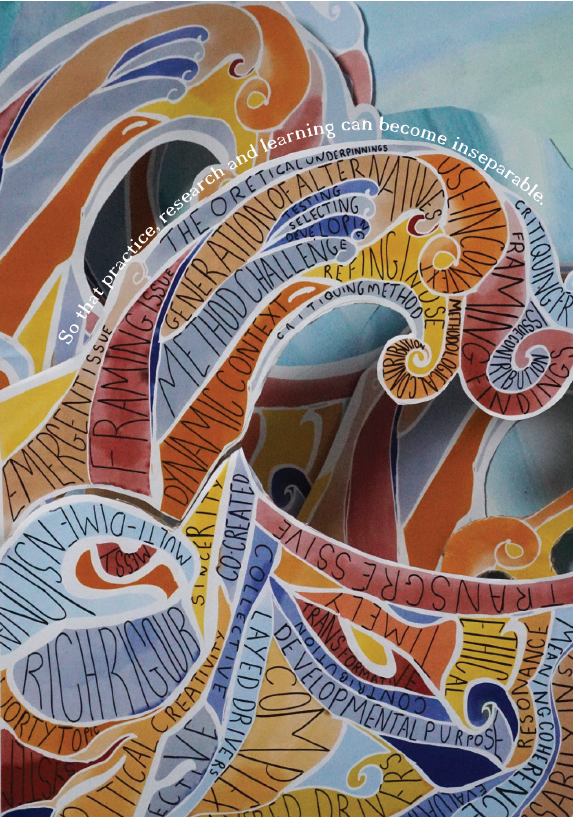
The later scenes in the piece trace our evolving framework of evaluative questions – questions that help professional practice researchers navigate emergent issues, methodological taboos, and ethical tensions. These questions are grounded in the Principles of Professional Practice (from Costley), Developmental Evaluation (Patton), and Big Tent Criteria (Tracy), but they are also shaped by our own lived challenges as researchers and mentors.
We visualised this as waves, gears, stars, rocks, and flowing diagrams – interconnected, messy, purposeful. A kind of visual grammar for research-in-motion.
A Different Kind of Paper
This is not a traditional article. In fact, the original submission contained almost no body text – just the visuals and a short accessible companion guide. The full piece is published here in Scope: Work-based Learning 6, and we hope it provokes, supports, and invites others to rethink what research can look like – especially when done from the inside.
What’s Next?
This visual piece builds on our work developing the Necessarily Insider Research Framework (NIRF) and follows our previous post, Seven Times Upon an Ism, in expanding the tools and lenses for navigating messy, ethically complex, and socially situated practice.
We’re continuing to develop the evaluative question sets into tools for learners, supervisors, and research communities – and we’re always looking for co-adventurers who are also trying to surf rather than simplify.
Because, as the final line of the piece reminds us:
So that practice, research and learning can become inseparable.

 Computing for Sustainability
June 30th, 2025 → 2:41 pm
[…] When we first introduced the Necessarily Insider Research Framework (NIRF), it was designed to help Professional Practice researchers navigate the often messy, ethically charged terrain of researching from within their own practice. The framework offered evaluative questions, not as a checklist, but as a landscape – a way to orient and reflect, to challenge and guide. […]