
When we introduced the updated Necessarily Insider Research Framework (NIRF), we offered it not as a checklist, but as a landscape. Now with reflexivity being made explicit, there are 192 evaluative prompts to consider as part of Professional Practice research. That might sound like too much – but it’s intentionally rich.
This isn’t a framework you “complete”. The point was never to answer every question. Rather, it’s to become the kind of researcher who could, if needed, respond to any of those questions – or any others like them that practice throws up.
The NIRF isn’t a narrowing down. It’s an invitation to become more expansive, more ready, more critically aware.
So What Do People Actually Do With It?
As the framework has been used in workshops, mentoring, and thesis journeys, we’ve paid attention—not to which questions are “used most often”, but to where movement happens.
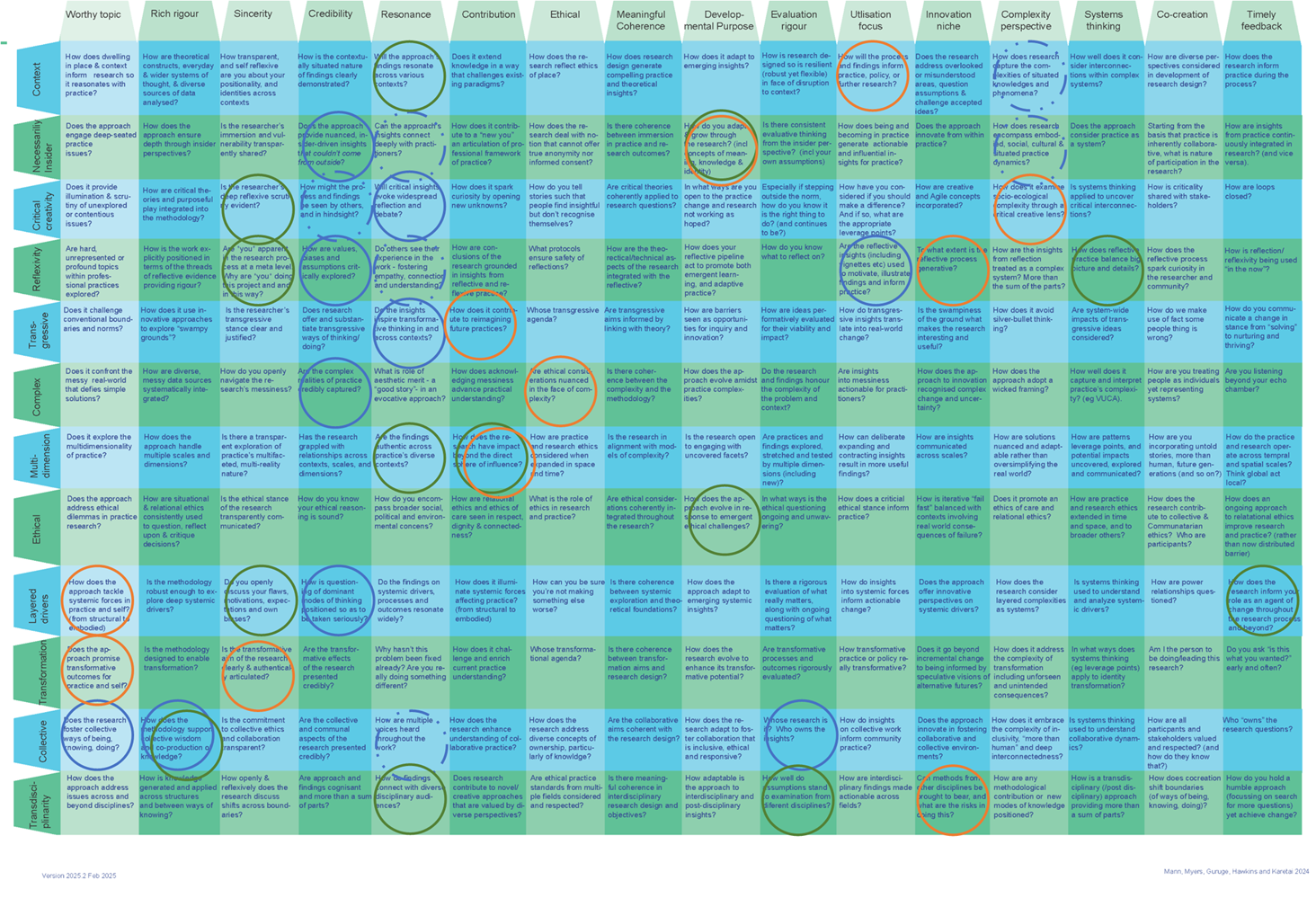
Where do people pause? Where do they say “I hadn’t thought of it like that”? Where does a piece of research suddenly shift?
These aren’t patterns in usage. They’re patterns in traction. Some questions consistently act as leverage points – opening up stuck projects, reframing assumptions, or surfacing difficult but necessary tensions.
Here are a few of those traction points:
- Noticing Positionality
“How do I describe the boundaries of this research situation – and who decides them?”
“What role am I occupying right now?” - Relational Ethics
“What existing relationships am I relying on?”
“Who is missing from this conversation, and why?” - Emotional Learning and Stuckness
“What’s uncomfortable right now?”
“Where am I resisting, and what might that tell me?” - Safe-to-Fail Experimentation
“What happens if I let go of a fixed outcome?”
“Where am I testing something without needing it to succeed?” - Process-Outcome Coherence
“Does my conclusion emerge from my process – or override it?”
“What difference is this research making already?”
These aren’t the best questions. They’re not a recommended starter set. They’re just the ones that have, in practice, nudged people sideways in useful ways.
Navigating the Tangle
We’ve started developing tools to support more fluid engagement:
- Randomised prompt spinners
- Thematic lens cards
- Interactive versions that let learners trace movement and reflection over time
But always with this caveat: the goal is not efficiency. The framework’s value isn’t in trimming it down to something more “manageable.” It’s in helping researchers grow into the complexity of their own practice.
There’s no shortcut to becoming someone who can meet a research moment with ethical clarity and methodological courage. The NIRF doesn’t hand you a method. It hands you a mirror.
What Kind of Researcher Are You Becoming?
That’s really the core of it. The NIRF, especially with the new Reflexivity row, supports not just better research, but the development of better researchers. It helps surface what was already there – the uncertainties, the insights, the awkwardness – and offers it back in the form of questions that you might be brave enough to answer.
Not all at once. But when it matters.
Download the updated Framework of Professional Practice (aka “the Tartan Canvas expansion set”).
Slides: https://www.slideshare.net/slideshow/identifying-necessary-necessarily-insider-insights-insights-from-insightful-necessary-insiders/278293962 Samuel Mann, Ruth Myers, Claire Good, Mawera Karetai, Ray O’Brien, and Adrian Woodhouse.

 Computing for Sustainability
Posted on June 30, 2025
0