
When we first introduced the Necessarily Insider Research Framework (NIRF), it was designed to help Professional Practice researchers navigate the often messy, ethically charged terrain of researching from within their own practice. The framework offered evaluative questions, not as a checklist, but as a landscape – a way to orient and reflect, to challenge and guide.
From the outset, reflection and reflexivity were core to our intent. They ran through the questions and underpinned the design. But as more learners engaged with the framework, it became clear: that reflexivity needed to be made visible and explicit.
So we added a new row.
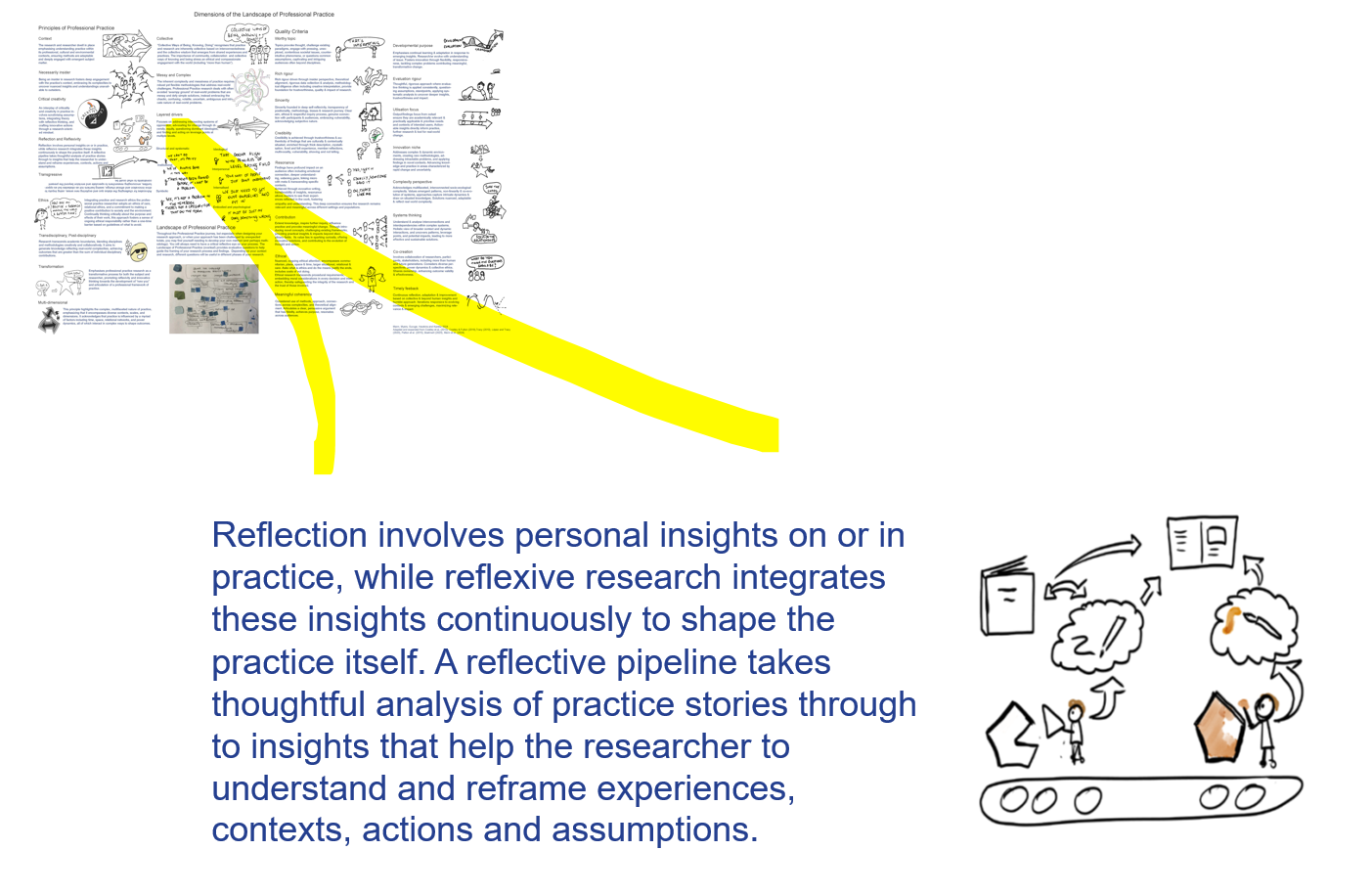
The Reflective Row
This new layer within the framework centres on researcher development and reflexivity. Drawing on Costley’s articulation of Professional Practice epistemology, Tracy’s evolving work on sincerity and meaningful coherence, and López & Tracy’s exploration of organisational autoethnography, we realised that the act of becoming a researcher was not just an invisible background process—it was central to the learning and to the ethics of the research itself.
This new row doesn’t just prompt reflection on practice—it interrogates how you, the researcher, show up in the work. It asks questions like:
- Why are you doing this research, in this way?
- How are your values, biases, and assumptions being surfaced and tested?
- Is your reflective process sparking new curiosity, adaptive shifts, or unexpected learning?
- How are these insights treated – not just as anecdotes, but as a system of generative complexity?

It also addresses safety, integration, and generativity: What protocols ensure the ethical handling of reflection? How are technical and theoretical aspects woven with reflexive insights? Can your conclusions credibly claim to emerge from a reflective pipeline?
At its core, this addition asks researchers to move beyond journal reflection, and into an active, emergent engagement with their own development, identity, and practice. It makes visible what was already vital – and invites deeper, more intentional researcher presence across every part of the journey.
These aren’t questions for the margins of a thesis. They shape the whole inquiry. Reflection involves personal insight on and in practice; reflexive research integrates those insights into the research design, method, and contribution.
A Framework That Learns
The NIRF was never meant to be static. We see it as an evolving, living scaffold—a research method that grows with each new project, challenge, and insight.
This reflective row is part of that evolution. It brings to the surface what was already there, and strengthens the ethical and developmental spine of the framework – making space for researchers to attend to who they are becoming as much as what they are researching.
We’re not done yet. In our next post, we’ll explore whether there are patterns – hotspots – within the NIRF: clusters of questions that consistently generate meaningful insight. Can we help learners (and supervisors) identify which questions might matter most? Can we find a path through the 192?
The updated framework, including the reflective row, was part of our WIL25 presentation: “Identifying Necessary Necessarily Insider Insights.”
Download the updated Framework of Professional Practice (aka “the Tartan Canvas expansion set”).


 Computing for Sustainability
June 30th, 2025 → 4:26 pm
[…] we introduced the updated Necessarily Insider Research Framework (NIRF), we offered it not as a checklist, but as a landscape. Now with reflexivity being made […]